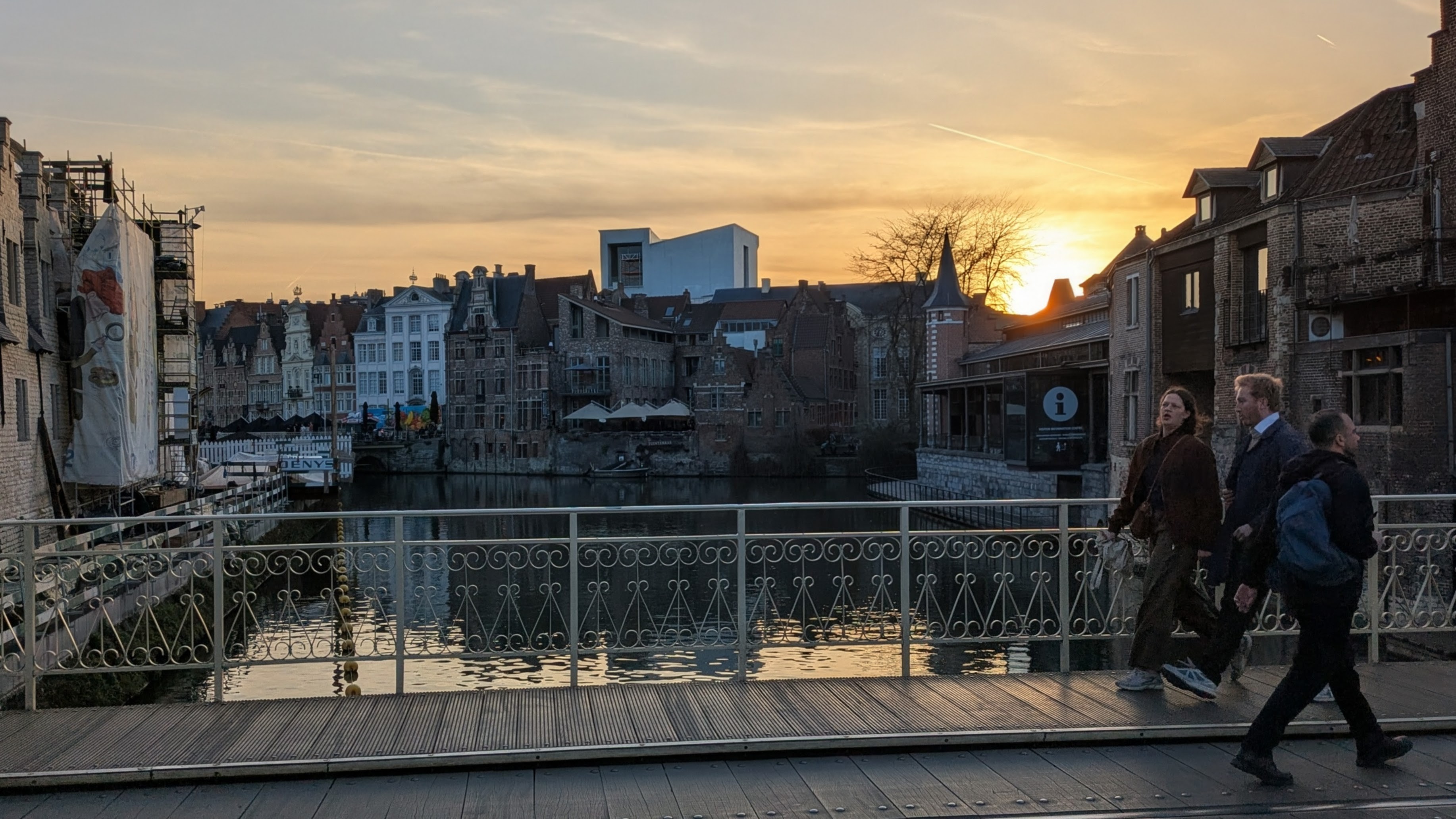
We’ve had a rough winter. Penetrating cold that clings to your bones. Ice dams, pipe freeze protocols, shutting down the upstairs bathroom. The kind of winter where the days blur together and you realize somewhere along the way that you’ve been going through motions rather than actually living inside them. You suspect you need something. You’re just not sure what, or how much.
We booked a flight to Amsterdam, but thought weather might make us need to cancel it. Thank goodness we didn’t.
The straightforward version — we went here, we saw this, we ate that — doesn’t capture it. We went somewhere so entirely foreign that we couldn’t coast through it. We had to pay attention, and it was exactly what we needed.
There’s a feeling I chase when I travel somewhere unfamiliar: the signs are in a language I can’t read, the rhythm of the streets is completely different from anything I know, and I become essentially invisible. I’m moving through a place, watching people do ordinary things: school letting out and hundreds of kids walking home through medieval streets, just going wherever kids go after school here, no parents, no carpool line, just children and their bikes and their backpacks heading off into the city. All of it is completely revelatory to me even though it’s just a Tuesday to them. I’m not watching a performance. I’m watching someone else’s life. That gap between their ordinary and my wonder is one of my favorite feelings in the world.
We landed in Amsterdam, tired from an overnight flight, and took the train south toward Rotterdam, where we’d planned to spend a few hours exploring before continuing on to Ghent. We put our luggage in lockers at Rotterdam Centraal, stepped outside, got something to drink, and sat down to sort out our onward connection. That’s when we found out there was a rail strike underway in Belgium.
The loose afternoon we’d imagined disappeared into logistics. We had a quick lunch and got moving.
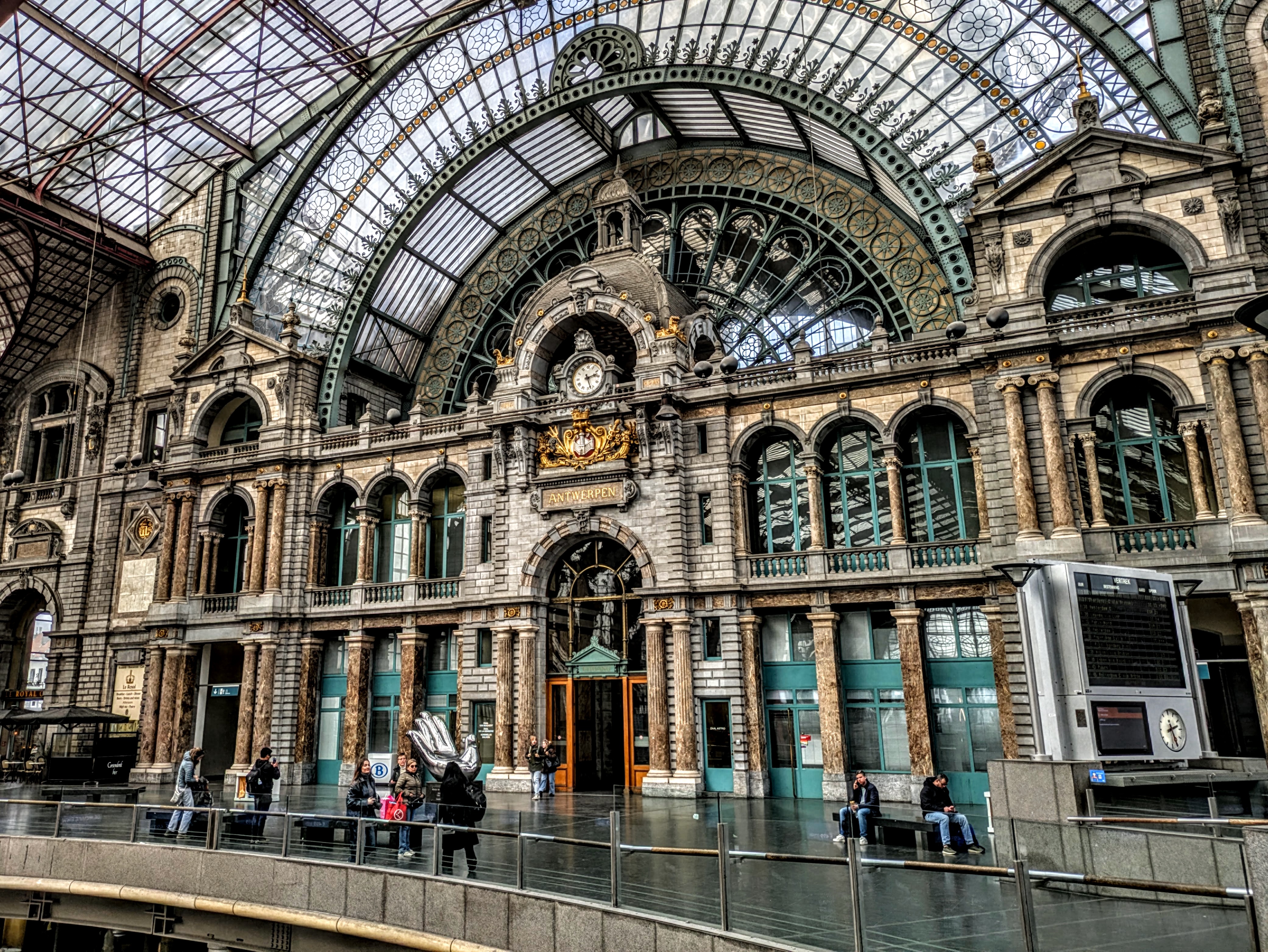
The route took us through Antwerp, where we transferred for the final leg to Ghent. Antwerp Centraal station stopped me completely. International trains arrive two levels underground; you ride escalator after escalator up through the building until the main hall opens above you, the old historic facade preserved and enclosed inside the modern structure, ornate stone and grand arches at a scale I wasn’t prepared for. It reminded me of the first time I walked into Grand Central. The kind of building that knows it’s beautiful and wants you to know it too. But we didn’t have time to linger, we had a train to catch.
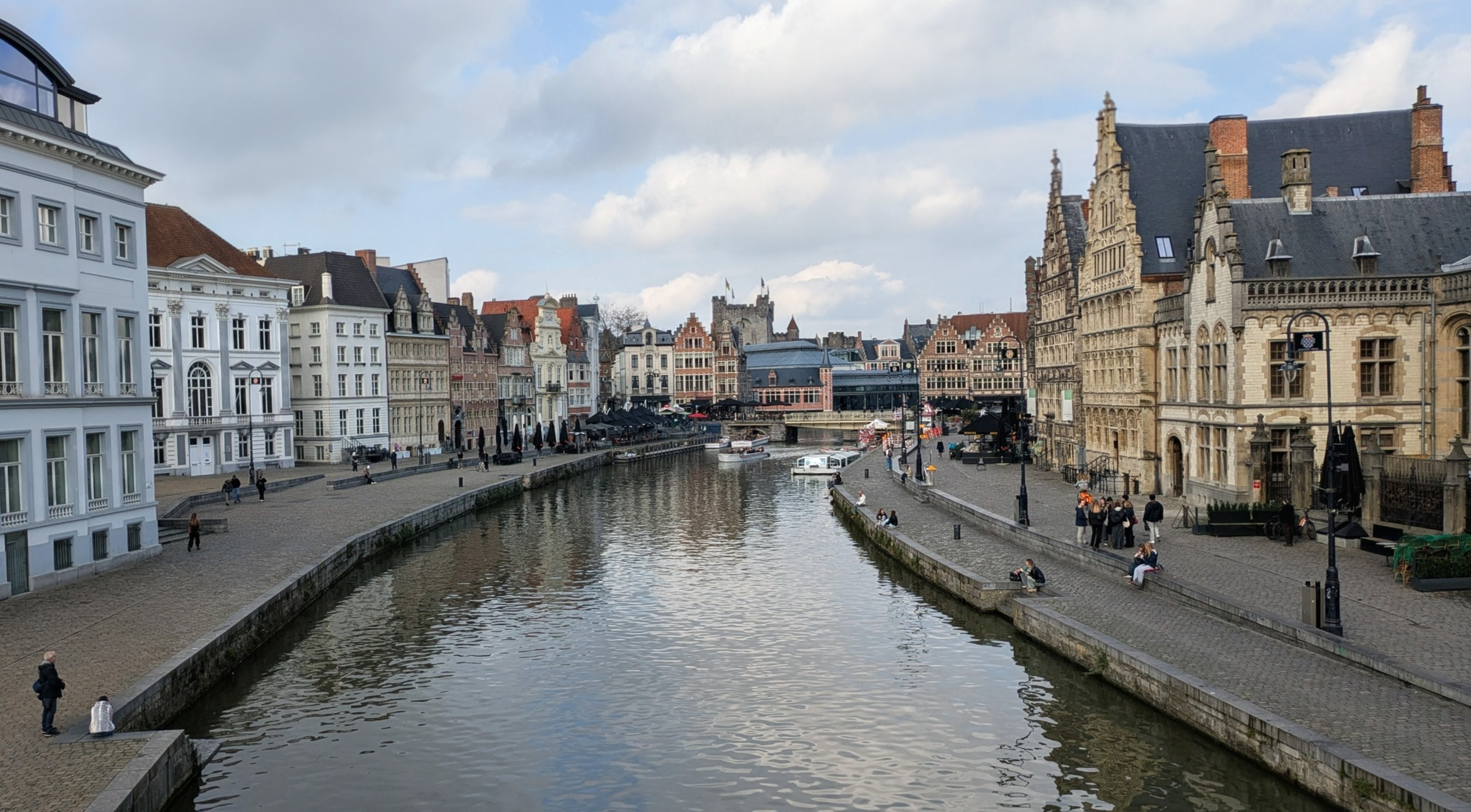
We spent the first half of the trip in Ghent. We chose it mostly for practical reasons: centrally located, reasonably priced, a good base for day trips. I was expecting something like the mid-sized cities I know from home: a hollowed-out industrial core, economically past its peak. What I found was so far from that expectation that it took a full day to recalibrate.
The city is woven through with history in a way that keeps catching you off guard. Cobblestone streets. A castle sitting right in the middle of everything. Canals with boats and walkways along the water. Churches and squares in every direction. Our hotel was one block from the main square. Two doors down, a plaque marked the building where John Quincy Adams signed the Treaty of Ghent, which ended the War of 1812. I stood outside it at dusk and thought: we had absolutely no idea what we were walking into.
We arrived exhausted, went to bed at eight and slept for fourteen hours. By the time we surfaced and started actually exploring, I already knew I wanted to come back.
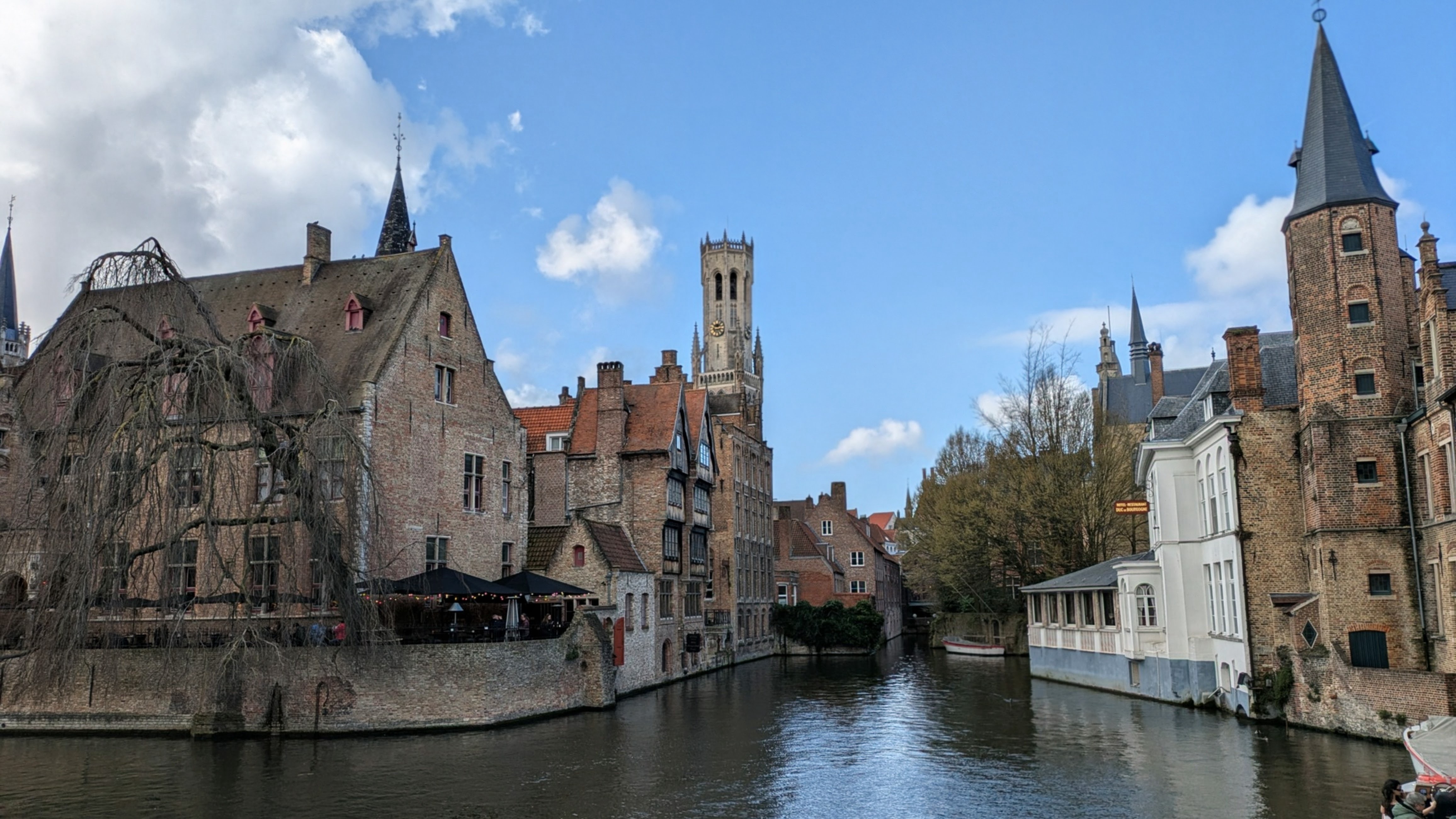
We took a day trip to Bruges, only twenty minutes away by train. It operates at an even more theatrical scale, so well-preserved it occasionally feels like a film set that happens to have real people in it. We spent part of the morning in pursuit of a vegan cinnamon roll. Every place we’d tried in Ghent had them on the menu; every place was sold out. Bruges had a shop that sold nothing else. We got our cinnamon rolls: coffee and apple streusel, split neatly for sharing. Some satisfactions are small and complete.
The trip wasn’t without its complications. A Belgian rail strike gave way to a nationwide general strike, which managed to affect every form of transportation in the country simultaneously. The day we moved from Ghent back to Amsterdam became an improvised relay of four trains. We were trying to reach Antwerp for an international connection north, but the first train stopped well short and the conductor told us we’d need a bus for the rest of the way. Looking at the map, it was a long way. It’s a lesson I seem to need to relearn every few years: talk to a person. Not the kiosk. Not the app. A person at a counter who knows what’s actually happening. A woman at the station window found us a connection to Antwerp, told us which track, and then walked out from behind the counter into the waiting room to tell us there was an earlier train coming in six minutes. She didn’t have to do that. I think about it a lot. From Antwerp we got as far as Rotterdam, and from Rotterdam a local train finally brought us into Amsterdam Centraal.
None of the chaos was welcome in the moment, but those are the stories we seem to keep telling.
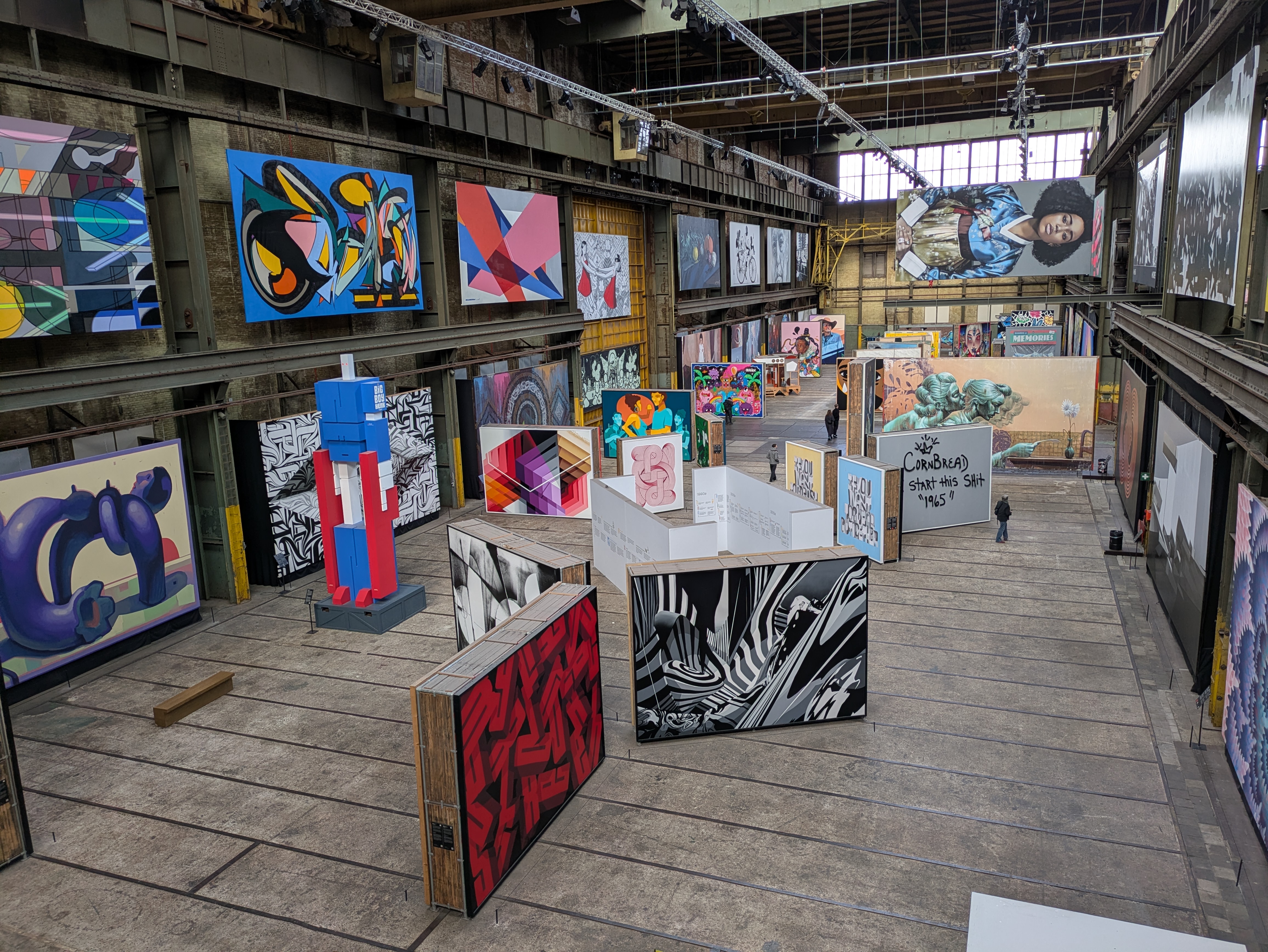
Amsterdam was bigger than I’d imagined, in the way that takes a day to fully absorb. You come out of the train station and there are people and trams and bikes moving in every direction as far as you can see. The rings of canals are extraordinary to walk along. The city felt endlessly explorable and genuinely open, the kind of place that seems unbothered by who you are. We crossed the water on a free ferry to the neighborhoods on the north side and found what might be our favorite museum out of everything we’ve ever visited: the STRAAT Museum, a converted warehouse filled floor-to-ceiling with street art. We were both completely absorbed for hours. Afterward we walked until we couldn’t, then found one more thing to see.
By the time we departed Amsterdam a week after we arrived, I was ready to come home. We landed back at Logan, cleared customs, and found the bus stop. The board said the next bus to where our car was parked was 56 minutes away. After a week running on European time, standing in the cold with exhaust blowing around us, that number felt crushing. About a minute later the bus pulled up — it had been running late, disappeared from the board, and then just appeared. We drove home through an empty highway in the middle of the night. The cats had opinions about how long we’d been gone. I went upstairs and crashed.
What I keep coming back to is how wrong I was about the magnitude of this trip. I knew I needed a reset. What I didn’t know was how much weight had been quietly accumulating, or how completely being somewhere foreign, somewhere that required my full attention and where coasting simply wasn’t an option, could lift it.
Happy to be home. So glad we went.